
Why a Competitive Runner Feels Tired and Hungry – A case study
“I try to eat balanced meals, but when I eat like this I feel more tired. Sometimes I need a second dinner in the evening and about every third day I feel like I’m overeating.”
In this case study, we discuss the diet, lifestyle, and mindset of a runner who has a problem with lack of energy and hunger.
After identifying the problems, we will propose solutions and create a customized action plan. I hope you find this practical analysis enlightening and helps you to better understand diet in a broader context.
Initial Analysis:
Hunter is a 33-year-old father of three who trains daily to run for exercise.
50-60 miles and 2-3 strength training sessions per week with weights, 30 min each.
There are also 2 harder running workouts, something like 16 x 400 or 10 x 800 or a longer tempo run.
He works in healthcare and his job involves visiting patients at home, which means he is on the road most of the day. He takes 8-10 thousand steps during the day.
His job largely influences his choices in food choices and eating during the day.
Based on what he has told me I suspect that the main cause of his difficulties will be inadequate energy intake. But to be sure, I asked Hunter to keep a record of his meals over the course of three days. We then had a video call where we explored other factors.
It’s essential to have a comprehensive picture, as first impressions may not be correct and would lead me to a course of action that won’t solve the problem.
Nutrition:
During the video call, Hunter mentioned that his meals fill him up during the day, but in the evening he gets greedy.
Many factors influence how hungry and full he feels, from sleep, to the macronutrient distribution of the food, portion size, stress and food quality.
Being hungry in the evening, having a lack of energy during the day, and even increased hunger every few days are signs of low energy intake.
This was subsequently confirmed by his food record.
Hunter’s energy intake was approximately 2500kcal.
Of this approx 120g protein, 89g fat, 320g carbohydrate.
Based on his body composition, and activity, I estimated his daily energy needs at 3200kcal – 3500kcal per day.
That’s a significant deficit that he may not feel on any given day, but will show up a day or two later. The consequence is reduced recovery, poor sleep, and greater hunger.


What to change?
There are a number of things we could change.
- Increase omega 3 intake,
- Reduce saturated fats,
- Reduce sodium
- Increase magnesium and
- Increase carbohydrate intake in the diet,
Hunter wanted to focus on food quality because he was unhappy with the amount of processed foods in his diet. While this would help him increase his intake of vitamins, minerals, and fiber, and might make him feel more full, it would not address the much larger problem of inadequate energy intake.
Even the healthiest food isn’t healthy when it doesn’t provide enough energy!
Runners are often surprised at how easy it is to get enough micronutrients in their diet without their diet being made up of only green smoothies and salads.
Adequate energy intake is a priority.
Hunter suggested swapping out some of the more processed sugars for fruit. I supported this suggestion because it would allow him to get a more nutritious diet without reducing sugars.
“I don’t eat enough because I’m afraid I’ll feel full. I used to be fat in high school and even in college. Maybe that fear is holding me back.”
The mind plays a huge role in changing eating habits. For people who have successfully lost weight and are afraid of gaining weight, the fear of gaining weight tends to be an obstacle. Hunter’s fear of gaining weight drives him to eat smaller meals throughout the day, which starves him by the evening and consequently makes it difficult for him to eat in moderation.
I suggested he focus on three balanced meals throughout the day of 500-700kcal and snacks between meals as needed. This will help him have enough energy during the day and not overeat later in the evening. At the same time, this will also improve the quality of his diet.

d2 1

d1 breakfast
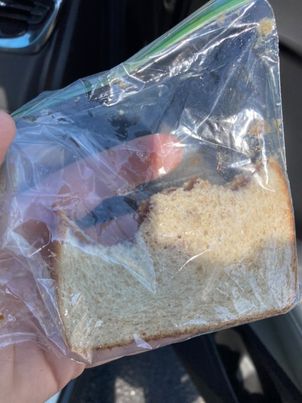
d1 PB jelly sandwich

d1 snack
Follow-up consultation after five days:
Adequate energy intake, eating appropriate foods, and when he eats is still an issue for Hunter, which is perfectly fine. You can’t change everything overnight.
Hunter followed his plan and after five days he noticed that although he was hungrier some days, he was more rested.
“I don’t drink coffee in the early afternoon anymore. I slept for 7-8 hours and felt more rested.”
Summary:
Finding the problem and its solution.
People tend to focus on one aspect of a problem that may not be the root of the problem. In this case, Hunter was focusing on the quality of his diet and also suspected that he was not eating enough, which was confirmed by logging his meals. At the same time, he did not consider sleep and caffeine and what role they played in his life.
What to change?
There are many changes Hunter could make. To make changes, it is essential to proceed in steps, not to change multiple things at once.
Goal, skill, action, practice
This was just the first step. Rarely is a problem rooted in one thing, and to achieve improvement it requires making multiple adjustments, which is unrealistic to do all at once.
We identified problems in the form of inadequate energy intake, insufficient sleep, and too much caffeine. I advised him to focus on sleep and Hunter suggested cutting out coffee in the afternoon. This helped him improve his overall condition.
We will then make small changes and observe how he is able to adhere to the new practices and habits and adjust our next course of action accordingly.
This is why I don’t do consultations and diet plans, but work with people long-term.
Ready to Become a High Performing Athlete?
If you're ready to stop guessing, start implementing a proven system that truly works. Book a free consultation. We'll review your current situation, and I’ll let you know whether I can help you reach your goals. No persuasion, no pressure—just an honest assessment.
If I can help, I’ll show you exactly how. If I can’t, I’ll let you know and point you in the right direction. Either way, you’ll walk away with a clear understanding of the next steps you need to take to move forward.
If you're serious about implementing what we discussed today, book your call.